

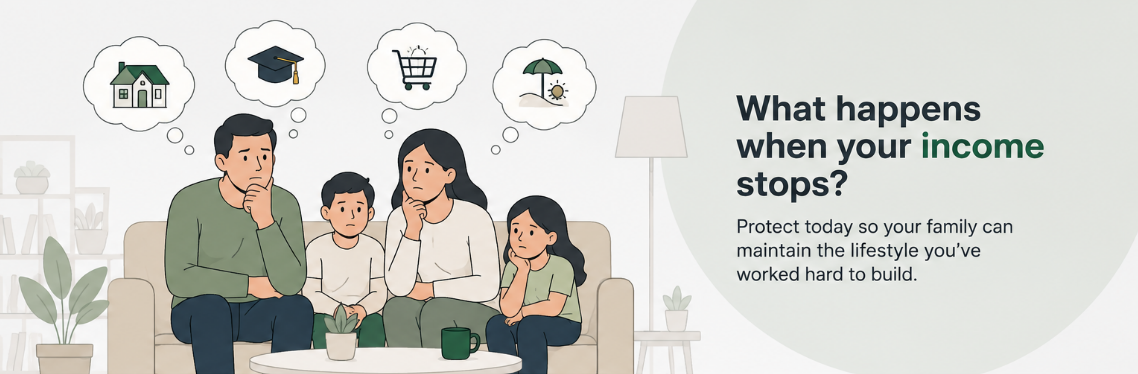
Could Your Family Maintain Their Lifestyle Without Your Income?


Could Your Family Maintain Their Lifestyle Without Your Income?
Most households insure their home before they insure their ability to earn. Here's why that may be backwards.
The question most families never ask
It's an ordinary Monday morning.
The mortgage is being paid. The kids are in school. The bills are covered, the portfolio is growing, and life feels stable. Then change one thing not your house, not your car, not your savings.
Your income.
Not forever. Just for six months.
Would everything above still hold? Could the mortgage still be paid, the children stay in the same school, the investments stay untouched? Or would the stress begin almost immediately?
For a lot of Australian families, that's a question they've simply never sat down and answered — not out of carelessness, but because no one has ever put it to them directly.
So let's put it to you directly.
Your most valuable asset probably isn't what you think
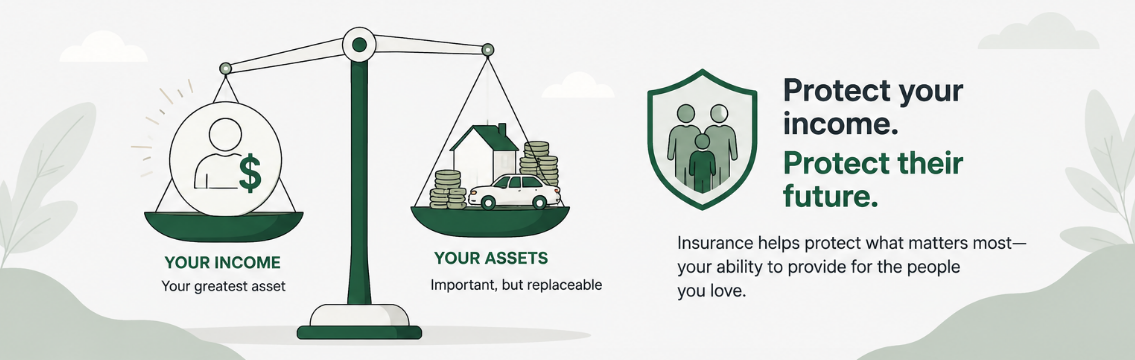
Ask most people to name their biggest asset and they'll point to the home, the super balance, the portfolio, the business.
For the majority of working Australians, it's none of those. It's their future earning capacity the income they haven't earned yet.
Run the numbers and the scale becomes obvious:
- A 40-year-old earning $150,000, working to 67, will earn around $4 million before retirement and that's before a single pay rise.
- At $250,000 a year, that figure climbs past $6 million.
Now consider what most of us actually insure. The home. The car. The phone in our pocket. All of it protected while millions of dollars of future income sit exposed.
We've insured the smaller assets and left the largest one uncovered.
Survival is not the same as continuity
Here's the distinction that changes how the whole question feels.
When income stops, most families think about survival keeping the mortgage paid and food on the table. But survival isn't the life you've built. The life you've built is the holidays, the kids' activities, the school fees, the university fund, the retirement contributions, the slow compounding of wealth over decades.
Financial survivalLifestyle continuityMortgage paidFamily holidays preservedFood on the tableChildren's activities continueEssential bills coveredEducation fundedRetirement contributions maintainedLong-term wealth building intact
Most people don't want to merely survive an income shock. They want their family to keep living the life they've spent years creating. That gap between scraping through and carrying on is exactly where the real risk sits.
What actually happens when the income stops
Numbers stay abstract until you watch them play out. So meet the Thompson family.
Two incomes totalling $220,000. An $850,000 mortgage. Two children in private school, two cars, one investment property. On paper, secure.
Then the primary earner is diagnosed with a serious illness and can't work. Here's how the next year unfolds:
- Month 1 — Savings absorb the shock. Nothing visible changes.
- Month 3 — The emergency fund is visibly shrinking.
- Month 6 — Investment contributions stop. Wealth-building pauses.
- Month 9 — Lifestyle adjustments begin. The small cuts start.
- Month 12 — The big decisions arrive: sell assets, draw down investments, refinance, pull the kids out of activities, push retirement further away.
Notice what the Thompsons didn't lack. They had assets. They had a good income. What they didn't have was a way to replace income once it stopped and assets, when forced to become income, get sold at the worst possible time.
Why we almost all underestimate this
It's not denial, exactly. It's optimism the same instinct that lets us drive to work without rehearsing the crash. We assume serious illness happens to other people.
But planning was never about predicting what will happen. It's about preparing for what could.
And the events that interrupt income cancer, heart disease, a serious mental health condition, a major injury, a long recovery — frequently don't end a life. They interrupt it for months or years. That's the scenario most people never picture, and it's precisely where the financial damage runs deepest.
Four questions worth sitting with
You don't need a financial planner to start here. You need an honest hour and these four:
- How long could we last without my income? One month? Three? Twelve? Most people are unsettled by their own answer.
- Which expenses continue regardless? Mortgage, rent, utilities, school fees, groceries, loan repayments, insurance premiums. Almost none of them disappear just because the income did.
- What would we have to sell? Savings, shares, super, the investment property and what does liquidating wealth to replace income do to the goals that wealth was for?
- What would daily life actually look like? Same as today, or a series of sacrifices? This is usually the most revealing of the four.
Think of it as a pyramid
Strong financial planning isn't only about growing wealth. It's about making sure the thing that generates the wealth can't be knocked out from under you.
Picture a pyramid. At the very base sits your income the engine that powers everything above it. Wrapped around that engine are the protective layers: your emergency savings, then your insurance cover. Only above those sit your investments and long-term wealth creation.
Most people pour their energy into the top of the pyramid. But the upper levels are only ever as safe as the foundation holding them up. If the engine stops and nothing protects it, every level above becomes vulnerable at once.
Protect the ability to create wealth before aggressively building it.
Signs you may have a gap
Any one of these is worth a closer look:
- People depend on your income.
- Your mortgage is larger than your savings.
- You haven't reviewed your insurance in more than three years.
- You rely solely on the default cover inside your super.
- You don't actually know how much income protection or life cover you hold.
- Your income has risen significantly since your last review — but your cover hasn't.
A more useful way to see insurance
Most people file insurance under "cost." Reframe it.
Insurance isn't a bet that something bad will happen. You don't buy life cover because you expect to die, or income protection because you expect to fall ill. You buy it because the financial consequences of those events are severe enough that you don't want your family's future decided by chance.
The point isn't to predict the risk. It's to make sure the risk doesn't get the final say.
The real question
So it was never really "Do I have insurance?"
The question is the one we started with:
If your income disappeared tomorrow, could your family keep living the life you've built together?
Because for most households, the house isn't the greatest asset. The capacity to earn is. And protecting it may be the quietest, most important financial decision you ever make.
Where to start
You don't need to overhaul anything today. You just need a clearer picture. Sit down and tally:
- Outstanding debts
- Annual household expenses
- Future education costs
- Existing assets and savings
- Current insurance cover
You may find your position is stronger than you feared. Or you may spot a gap worth closing on your terms, calmly, now, rather than under pressure later, when life has already forced the issue.
This article is general information only and does not take into account your personal objectives, financial situation or needs. Before acting on any of it, consider whether it's appropriate for you and seek advice from a licensed financial adviser.




PM mental models

Our top 10 Javascript frameworks to use



© 2025 Bamboo Wealth Pty Ltd.
*GENERAL ADVICE WARNING*
Any advice in this site is of a general nature only and has not been tailored to your personal circumstances.
Please seek personal advice prior to acting on this information.
ABN: 37 615 483 308 - ACN: 615 483 308 - Hejaz AFSL: 517686
.avif)